Have you ever looked at your clock after what felt like twenty minutes of coding, only to realize four hours had vanished? That is the “flow state.” In the world of software engineering and computer science, this state of mind—often called “the zone”—is the holy grail of productivity. It is a mental space where the challenge of the code perfectly matches your skill level, making distractions disappear and logic feel effortless. However, maintaining this level of hyperfocus for a six-hour stretch isn’t about drinking more coffee; it is about managing your brain’s biological and cognitive resources through strategic “Energy Audits.”
Achieving this level of deep work requires a structured approach to your daily routine and your digital environment. Many students and professionals struggle to find this rhythm because they are bogged down by administrative tasks or poorly structured research. If you find that technical hurdles are breaking your concentration, seeking assignment writing help from a trusted brand like myassignmenthelp can provide the structural support needed to clear your schedule for high-level logic. By offloading the dense documentation or formatting of a project, you protect your “cognitive budget,” allowing you to spend your most valuable mental energy on actual problem-solving rather than getting stuck in the weeds of academic requirements.
1. The Neuroscience of “The Zone”
To code for six hours without hitting a wall, you must understand how your brain handles “Cognitive Load.” Every time you switch from a coding tab to a social media notification, your brain pays a “switching cost.” It can take up to 20 minutes to fully re-enter a state of deep focus after a single interruption. This is because of “attention residue”—a phenomenon where part of your brain is still processing the last thing you looked at, leaving less power for the current task.
During a flow state, your brain undergoes “transient hypofrontality.” This is a fancy way of saying the part of your brain responsible for self-criticism and doubt—the prefrontal cortex—quiets down. This allows your subconscious to take over the heavy lifting of syntax and logic. To trigger this, you need a clear goal and immediate feedback. When your code runs successfully or fails with a specific error, that feedback loop keeps the dopamine flowing, which is the fuel for long-term concentration.
2. Environment Engineering: The “Zero-Distraction” IDE
Your environment is either an ally or an enemy of your focus. Physical ergonomics play a massive role in mental fatigue; if your back hurts or your eyes are strained from poor lighting, your brain will redirect energy away from your code to manage that physical discomfort. This is often referred to as “Environmental Friction.”
Start by optimizing your Integrated Development Environment (IDE). A cluttered screen leads to a cluttered mind. Use “Zen Mode” or “Distraction-Free Mode” to hide sidebars, terminal outputs (unless needed), and line numbers that you aren’t currently using. Furthermore, consider the “Analog First” rule. Before you type a single line of code, sketch the logic on a piece of paper. This separates the “architecting” phase from the “typing” phase, reducing the mental friction of trying to design and debug at the same time.
3. Managing the “Cognitive Load Funnel”
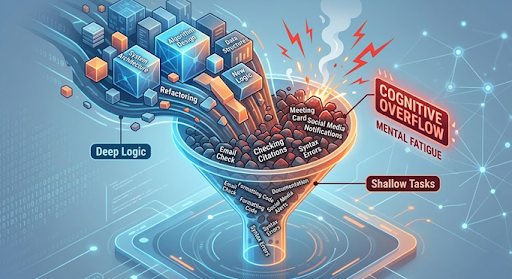
Cognitive load is like a funnel. If you pour too much information into it at once—trying to learn a new framework while simultaneously solving a complex algorithm—the funnel overflows, and you experience mental fatigue. To stay in the flow for six hours, you must “chunk” your tasks into manageable layers.
| Phase of Focus | Task Type | Mental Energy Required | Suggested Duration |
| Layer 1: Deep Logic | Architecture, Algorithms, New Logic | High (90-100%) | 120 Minutes |
| Layer 2: Refactoring | Cleaning code, Improving Efficiency | Medium (50-70%) | 90 Minutes |
| Layer 3: Housekeeping | Documentation, Testing, UI Tweaks | Low (20-40%) | 60 Minutes |
Break your coding session into these distinct blocks. The first block should be for “Deep Logic,” where you tackle the hardest problems while your brain is fresh. The second block is for “Refactoring and Cleanup,” and the final block is for “Documentation and Testing.” If you find that the sheer volume of your university workload is making this funnel overflow, utilizing programming assignment help can be a strategic way to ensure your larger projects stay on track without venturing into burnout. This allows you to focus on the core “Deep Logic” while experts help verify the foundational requirements of your computer science curriculum.
4. The 90-Minute Pulse: Why Breaks Save Your Brain
It sounds counterintuitive, but the secret to coding for six hours is knowing when to stop. Human focus follows “ultradian rhythms,” which are cycles of about 90 to 120 minutes. After this point, your brain’s ability to process complex logic begins to drop sharply as “Decision Fatigue” sets in.
Instead of pushing through the brain fog, use the “90-15” rule. Code intensely for 90 minutes, then step away from all screens for 15 minutes. Do not check your phone. Physical movement, like a quick walk or even just stretching, flushes metabolic waste from your brain and resets your nervous system. This recovery period is what allows you to come back for a second and third 90-minute block with the same intensity as the first.
5. Biohacking for Long-Term Coding Stamina
What you put into your body dictates how long your brain can perform. High-sugar snacks lead to a “glucose spike” followed by a crash, which is the fastest way to end a flow state. Instead, focus on “slow-burn” fuels like complex carbohydrates and healthy fats that provide a steady stream of energy to your neurons.
Hydration is also a hidden factor in coding errors. Even 2% dehydration can lead to a significant increase in syntax errors and logical fallacies. Keep a large water bottle at your desk, but avoid excessive caffeine. While one or two cups of coffee can help initiate focus, too much leads to “jittery” thinking, where your mind jumps between ideas too quickly to actually implement any of them. Think of your brain like a CPU: if you overclock it too hard with stimulants without proper cooling (rest and water), it will eventually throttle its performance to prevent a total system crash.
6. Solving the “Context Switching” Crisis
One of the biggest killers of the flow state is the “context switch”—the act of moving from one unrelated task to another. For a student, this might mean moving from a Python script to a history essay and then back to a Java project. This creates “attention residue,” where parts of your brain are still stuck on the previous task, making the new task feel twice as difficult.
To combat this, use “The Hemingway Bridge.” Never finish a coding session at a point where you are completely stuck. Always stop when you know exactly what the next three lines of code should be. This makes it significantly easier to “re-enter” the flow state the next day because your brain doesn’t have to waste energy figuring out where it left off. You are essentially leaving a breadcrumb trail for your future self to follow back into the zone.
7. The Role of Professional Support in Career Longevity
In the competitive world of software development, the pressure to perform is constant. Students often feel they must do everything alone to prove their worth. However, elite developers know that the best work is produced through collaboration and the smart use of resources. This is known as “Leveraged Productivity.”
Whether you are building a commercial app or finishing a university degree, knowing when to leverage external expertise is a sign of professional maturity. Balancing the “Flow State” with a heavy academic load is a skill in itself. By using structured support for your more tedious technical requirements, you aren’t just getting a grade; you are practicing the art of project management. You are learning to prioritize the “creative engine” of your work while ensuring the “technical infrastructure” is handled by reliable partners. This balance is what separates the developers who burn out in two years from those who thrive for twenty.
8. Cognitive Load and the “Deep Work” Ratio
To truly master the 6-hour session, you must track your “Deep Work Ratio.” This is the amount of time spent on cognitively demanding tasks versus “shallow work” like answering emails or formatting bibliographies. High-performers aim for a ratio of at least 70/30.
If your ratio is inverted—meaning you spend 70% of your time on administrative academic tasks—your growth as a programmer will stall. This is where strategic delegation becomes your greatest asset. By automating or outsourcing the shallow tasks, you protect the limited window of time where your brain is capable of peak architectural thinking.
Summary: The Coder’s Focus Checklist
- Audit Your Environment: Remove the phone, clean the desk, and set the IDE to Zen mode to reduce environmental friction.
- Architect Before You Code: Use paper and pen to map logic. This separates “Thinking” from “Typing.”
- Respect the Pulse: Use 90-minute work blocks followed by 15-minute “screen-free” breaks to flush metabolic waste.
- Outsource the Friction: Don’t let documentation or repetitive tasks break your focus; use professional resources like myassignmenthelp to keep your schedule clear for core logic.
- Fuel the Machine: Prioritize hydration and slow-burn nutrients over high-sugar energy drinks to avoid the glucose crash.
By treating your brain as a finite resource and protecting it from the “friction” of daily distractions, you can turn a grueling six-hour grind into a rewarding, high-output flow state. Coding is a marathon of the mind, not a sprint—learn to pace your mental energy, and the results will rank you among the elite.
Frequently Asked Questions
- What exactly is a “flow state” in programming?
A flow state is a period of optimal concentration where a developer becomes fully immersed in their code. During this time, self-consciousness drops, and the ability to solve complex logical problems feels more fluid and automatic, leading to significantly higher productivity.
- How long can a person realistically maintain deep focus?
Research into ultradian rhythms suggests the human brain can maintain peak focus for about 90 to 120 minutes before needing a reset. Attempting to push past this without a break often leads to “decision fatigue,” where the quality of work decreases and syntax errors increase.
- Why is “context switching” considered harmful to coding?
Every time you switch tasks—such as checking an email or a social media alert—your brain pays a “switching cost.” It leaves behind “attention residue,” meaning part of your mental energy is still stuck on the previous task, which prevents you from reaching a high-level flow state.
- Can physical habits actually improve my debugging speed?
Yes. Cognitive performance is tied to biological health. Proper hydration, ergonomic seating to reduce physical strain, and “slow-burn” nutrition prevent the mental fog and irritability that often lead to getting stuck on simple logical bugs for hours.
About The Author
Ella Thompson is a senior content strategist at MyAssignmentHelp with over a decade of experience in academic consulting. She specializes in bridging the gap between complex research and student-friendly communication, helping learners navigate the challenges of modern education with clarity and precision.